
If your cat devours its food very quickly and barely chews, three steps are immediately useful: reduce portions and feed more frequently, use an anti-gorging bowl, and set up separate feeding stations for multiple cats. These measures relieve the stomach, reduce air swallowing, and allow the feeling of fullness to set in.
When to see a vet immediately? Blood in vomit, persistent nausea for more than two days, significant weight loss, or sudden lethargy are red flags. In such cases, a change of bowl won't help, only a veterinary examination will.
According to Rover, a meal finished in about two minutes or less is considered eating too quickly. This increases the risk of vomiting immediately after eating and significantly delays the feeling of fullness.
Table of Contents
- Why does your cat eat so fast? Causes at a glance
- Is fast eating dangerous? Risks and warning signs
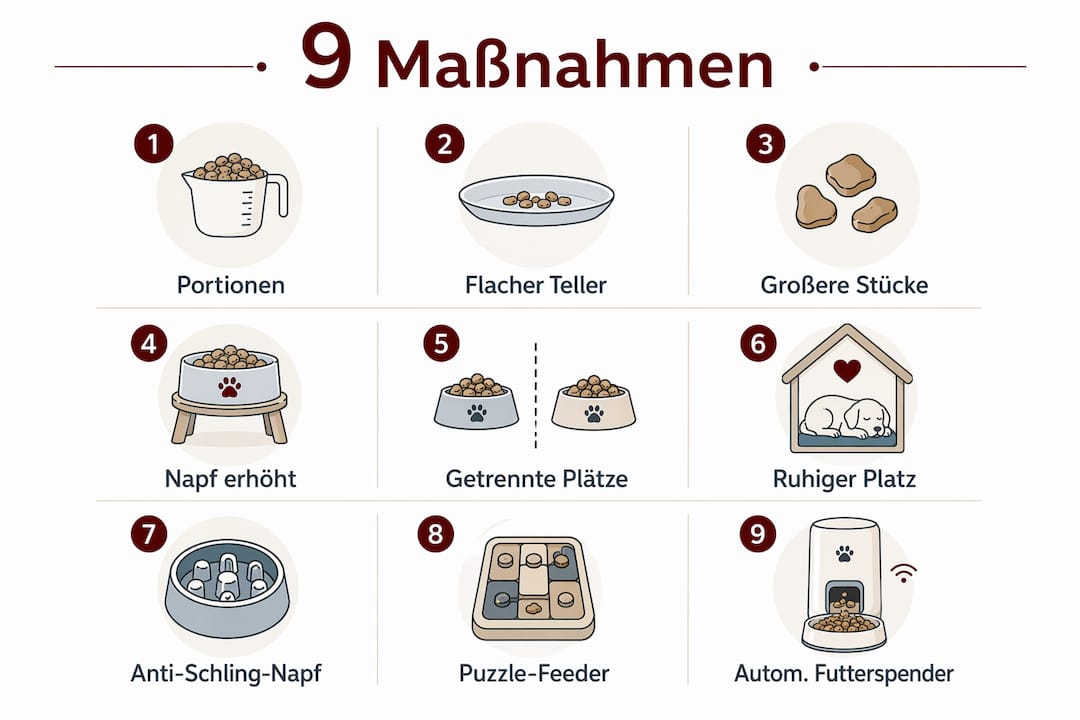
- 9 practical measures against fast eating
- When to see a vet? Red flags and how to prepare
- Key takeaways
- What we at Petcartsupply think about the gorging problem
- Petcartsupply: Practical helpers against gorging
- Further sources and recommended contacts
Why does your cat eat so fast? Causes at a glance
Fast gorging is rarely a whim. Usually, there is a specific cause behind it, which can be divided into several categories.
Behavioral causes
- Food aggression in multi-cat households: Cats living with other cats often eat faster out of fear that the other cat will take their food. Even if there is enough food, the feeling of competition persists.
- Past experiences of hunger: Cats from shelters or the street have learned that food can be scarce. This pattern often remains, even if the supply has long been secured.
- Stress and insecurity: Moves, new housemates, or noisy environments can cause a cat to feel pressured during meals and eat hastily.
Environmental factors
Fixed, too infrequent feeding times exacerbate the problem. Giving a cat a large portion only twice a day creates a feeling of scarcity. A restless feeding place, too little space between bowls, or a bowl that is too deep and irritates the whiskers can also increase the speed.
Medical causes
Parasites like worms, inflammatory bowel disease, dental pain, or an overactive thyroid can cause a cat to not feel full despite eating a lot, or to experience pain when chewing, leading it to swallow rather than chew. Particularly noticeable: The cat eats a lot but still loses weight. This is a clear signal to see the vet.
Pro tip: Observe your cat specifically for seven days: How long does a meal take? Does it chew at all? Does vomiting occur? These simple metrics help you narrow down the most likely cause and provide specific information during your vet visit.
Is fast eating dangerous? Risks and warning signs
In short: Yes, in the long run. The consequences range from harmless gagging to serious digestive problems.
| Symptom | Cause | Urgency |
|---|---|---|
| Vomiting immediately after a meal | Stomach overloaded, too much air swallowed | Medium: Take measures |
| Bloating, abdominal pain | Air swallowing during hasty eating | Medium: Change feeding routine |
| Weight gain despite normal portion | Feeling of fullness sets in too late | Medium: Control portions |
| Coughing, gagging while eating | Aspiration: Food enters airways | High: See a vet |
| Weight loss despite eating a lot | Possible illness (parasites, thyroid) | High: See a vet |
| Blood in vomit | Mucosal injury or serious illness | Immediate: See a vet |
The delayed feeling of fullness is underestimated. Those who eat too quickly overload their stomach before the brain sends the "full" signal. This leads to long-term obesity, even if the portion size is actually correct.
Important: Occasional vomiting after a meal is not unusual in cats. If it happens regularly, i.e., several times a week, it should be investigated. Fast gorging can also promote the formation of hairballs because insufficient chewing and air swallowing disrupt stomach emptying.
9 practical measures against fast eating
1. Reduce portions and feed more frequently
Instead of two large meals, distribute four to six small ones throughout the day. This reduces the feeling of scarcity and relieves the stomach. If you work during the day, you can use an automatic feeder, more on that in point 9.
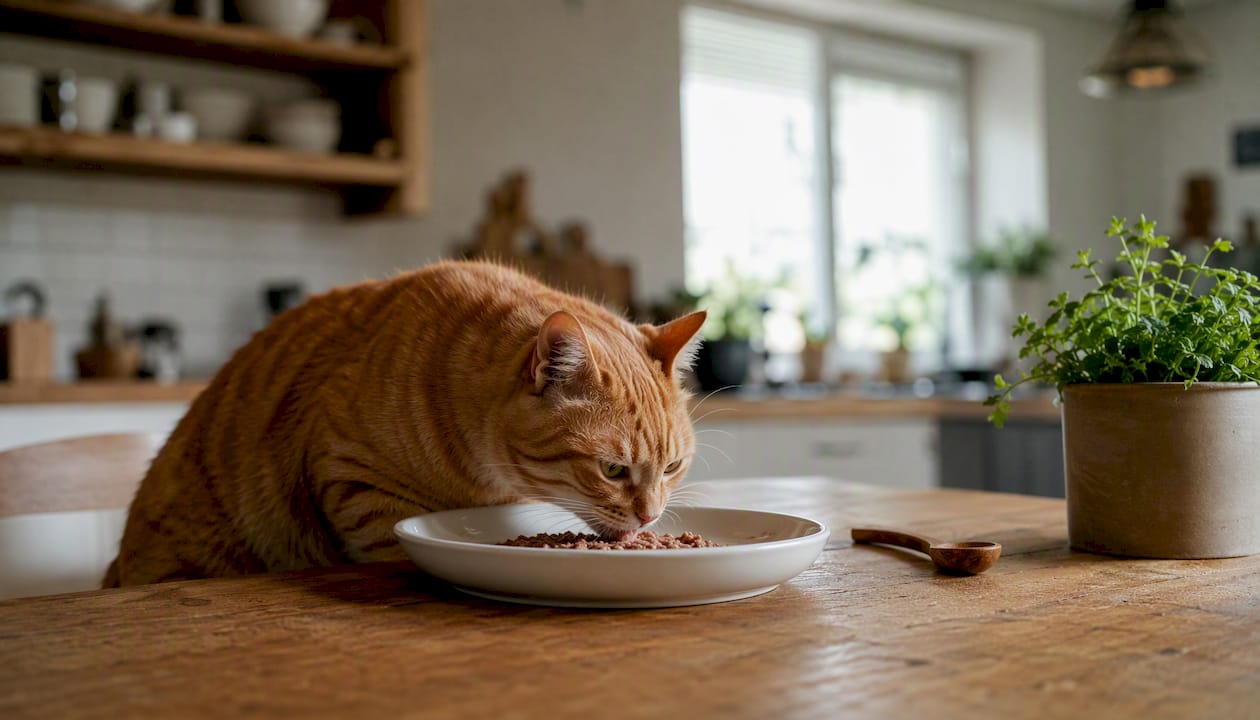
2. Serve food on a flat plate
Spread wet food thinly on a flat plate instead of putting it in a deep bowl. The cat has to make more effort to pick up each portion and automatically eats slower. Also works with dry food spread out on a large plate.
3. Offer larger food pieces
Finely pureed wet food can be swallowed without chewing. Coarsely chopped food forces the cat to break down each bite. Observe carefully at the first attempt: Some cats try to swallow large pieces at once.
4. Elevate the bowl
The bowl should be about the height of the sternum. In this posture, the cat swallows less air, which significantly reduces bloating and vomiting after the meal.
5. Set up separate feeding stations for multiple cats
In multi-cat households, feed each cat in its own room, closing doors until everyone is finished. Each cat needs its own bowl. Only when everyone is finished can the doors be reopened. This measure alone often brings immediate improvement for food-aggressive cats.
6. Choose a quiet, fixed feeding place
Noise, hustle and bustle, or the presence of other animals during meals increase stress levels. A fixed, quiet place, always the same, gives the cat security and noticeably slows down eating. If you have an anxious cat, you can also offer a sheltered retreat nearby so it can relax after the meal.
7. Use an anti-gorging bowl
An anti-gorging bowl is the most direct solution: Through ridges, nubs, or labyrinth patterns, the cat has to take smaller portions and automatically takes more breaks. For cats: flat nubs instead of deep labyrinths, because sensitive whiskers often reject narrow, deep vessels. The CareHaven Slow Food Bowl from Petcartsupply is designed exactly for this requirement, with a moderate pattern that is also suitable for wet food and easy to clean.
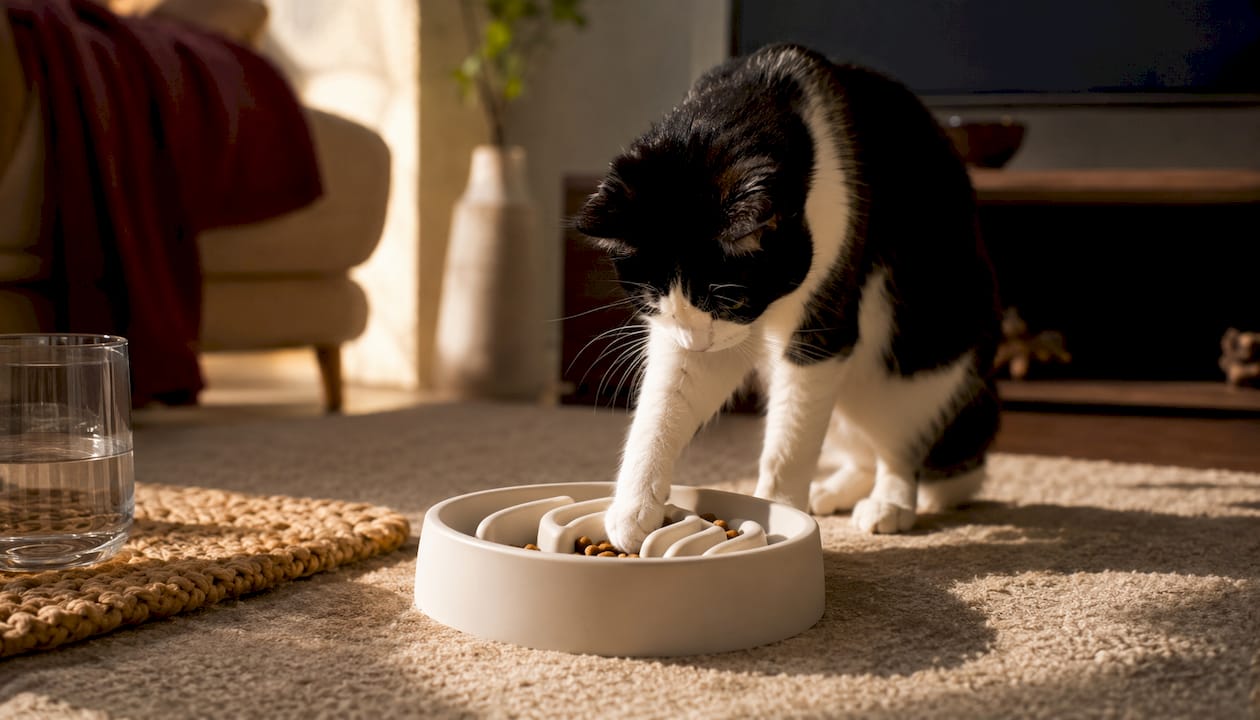
For many cats, the effect is noticeable with the very first meal: eating time is extended, and post-meal vomiting decreases. The material and weight of the bowl also play a role. Lightweight plastic bowls are often knocked over by active cats; a heavier model remains stable.
Pro tip: Start with a half-filled portion in the new anti-gorging bowl and mix in some favorite treats. This way, your cat will associate the unfamiliar bowl positively more quickly and accept the slower pace more easily.
8. Puzzle feeders and food games as a supplement
Labyrinth food boards or food balls are well suited for playful cats who also need mental stimulation. However, they should not replace the anti-gorging bowl but rather supplement it. As a daily main dish, they are less practical because wet food in deep structures is difficult to clean.
9. Use an automatic feeder
Those who are not at home during the day can use the CareHaven Smart Automatic Feeder from Petcartsupply to program fixed feeding times and small portions. This prevents the cat from waiting for hours for its meal and then devouring everything at once. For indoor cats who are alone, this is one of the most effective measures of all.
When to see a vet? Red flags and how to prepare
Behavioral measures help most cats. But there are situations where they are not enough.
Red flags that require a veterinary examination:
| Symptom | Possible cause |
|---|---|
| Vomiting several times a week, despite measures | Inflammatory bowel disease, parasites |
| Weight loss with simultaneous high food intake | Hyperthyroidism, diabetes, worms |
| Blood in vomit or stool | Mucosal injury, serious illness |
| Significantly altered drinking behavior | Kidney problems, diabetes |
| Lethargy, withdrawal, loss of appetite | Pain, systemic illness |
Common veterinary examinations include a clinical examination, blood count, stool analysis for parasites, and ultrasound or X-rays if foreign bodies or tumors are suspected.
Well prepared for the practice: Keep a short food diary for at least a week. Note meal duration, how often vomiting occurs, and whether weight changes. A short video of the meal on your smartphone is often more valuable to the vet than any description. Also, bring a list of all medications and supplements.
The vet can recommend a bland diet, treat parasites, or initiate further diagnostics. Coming well prepared saves time and leads to a clearer diagnosis faster.
Key takeaways
If your cat eats too fast, smaller portions, an anti-gorging bowl, and separate feeding are the quickest helpers, while persistent symptoms like weight loss or blood in vomit always require veterinary clarification.
| Topic | Details |
|---|---|
| Threshold for eating too fast | Meal finished in about two minutes or less, hardly any chewing movements visible. |
| Immediate measures | Divide portions into four to six small meals daily, elevate the bowl. |
| Choosing an anti-gorging bowl | Prefer flat nubs, deep labyrinths irritate sensitive whiskers. |
| Multi-cat household | Separate feeding stations in different rooms immediately reduce food aggression. |
| Petcartsupply products | CareHaven Slow Food Bowl and Smart Automatic Feeder are available directly in the shop. |
What we at Petcartsupply think about the gorging problem
Most guides on fast eating recommend anti-gorging bowls as a first measure. This is true, but only partially. A bowl alone will not permanently change behavior if the underlying cause – stress, food aggression, or an unsuitable feeding routine – persists.
What really works is the combination: bowl plus routine plus environment. A quiet feeding place, fixed times, small portions. The bowl is the tool, but the routine is the foundation. If you only change the bowl and nothing else, you will find after a few weeks that the cat has learned to empty the new bowl quickly too.
In addition, there is a point that many underestimate: behavioral changes in cats take time. The gorging pattern is often learned and deeply ingrained. Consistency over several weeks is necessary for a new pace to truly establish itself. If you give up after three days because the cat is still eating fast, you have stopped the change too early.
Petcartsupply's CareHaven products are designed precisely for these requirements: flat structures that are gentle on whiskers, stable material that doesn't tip over, and a design that blends into any household. This is no coincidence, but the result of a well-thought-out approach where function and everyday usability are equally valued.
Petcartsupply: Practical helpers against gorging
Anyone who wants to improve their cat's eating behavior does not need a complicated solution. The CareHaven Slow Food Bowl from Petcartsupply slows down food intake with a flat nubs pattern specifically designed for cats' sensitive whiskers. Suitable for wet and dry food, easy to clean, and heavy enough not to slide across the floor.

For those not at home during the day, the CareHaven Smart Automatic Feeder is a useful addition: feeding times and portion sizes can be programmed so that the cat receives regular small meals even without supervision. Both products are available through the Petcartsupply shop with shipping to Germany. If you are also looking for comfort products for your cat, you will find more items in the Cozy Comfort & Calming Collection that reduce stress and support well-being.
Further sources and recommended contacts
For those who want to delve deeper or have specific medical questions:
- Cornell Feline Health Center (vet.cornell.edu): In-depth information on inflammatory bowel disease in cats, which can be behind recurrent vomiting.
- Rover Guide (rover.com): Practical overview of causes and measures for fast-eating cats.
- Haustierratgeber.de: Ausführliche Vergleiche und Kaufratgeber zu Anti-Schling-Näpfen für Katzen.
- Ecats.de (ecats.de): Hintergrundinformationen zum natürlichen Fressverhalten von Katzen und saisonalen Schwankungen.
- Tierherzen.de (tierherzen.de): Praktische Lösungsansätze bei Katzen, die schlingen und erbrechen.
Hinweis: Dieser Artikel dient der allgemeinen Information und ersetzt keine tierärztliche Beratung. Bei anhaltenden Symptomen oder Unsicherheit immer eine Tierarztpraxis aufsuchen.
Empfehlung
- Slow Food Bowl Anti Choking Cat Bowl Dog Basin Puzzle Feeder Healthy P – CareHaven
- Automatic Pet Feeder Smart Food Dispenser For Cats Dogs Timer Stainles – CareHaven
- Pet APP Smart Cat Drinking Water Motor Cycle Filter – CareHaven
- Smart Teaser Cat Toy Electric UFO Cat Teaser Stick With Bell Training – CareHaven